
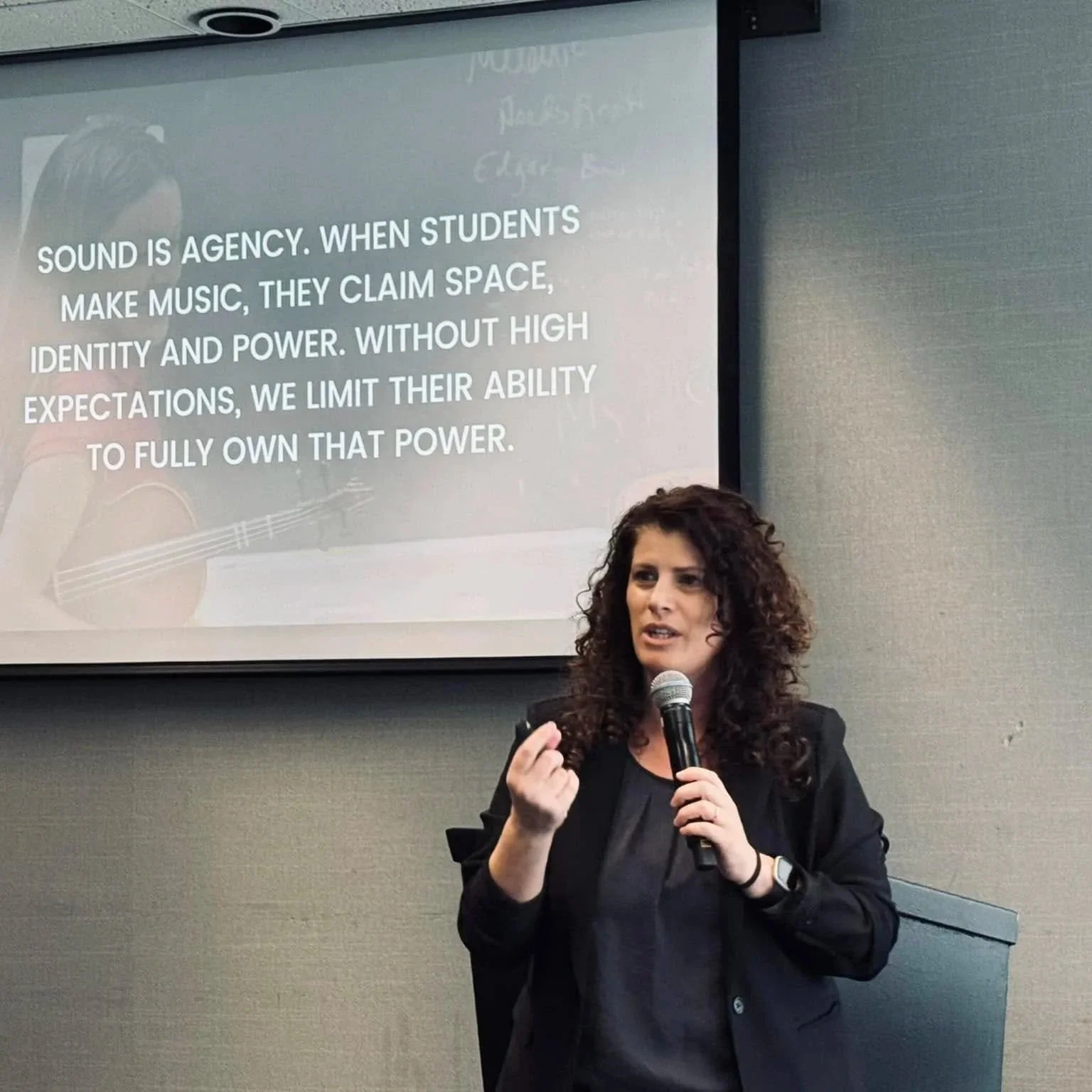
Hi, I’m Nicole Melrose.
International Clinician, Speaker, and Founder of StringRise.
A string teacher put a violin in my hands when I was eleven years old. I had no idea in that moment how pivotal and transformative it would become.
I grew up in a low socioeconomic household, in a home shaped by stress, instability, and a lot of unspoken trauma. My nervous system and brain were being shaped by survival long before I had language for it.
When that violin came into my life, everything changed. I didn’t just learn music. I began to heal. Through a teacher who prioritized my setup, my sound production, and the experience of making a beautiful sound, my brain and nervous system began to shift. The power of sound gave me a different story about who I was and what might be possible.
By the time I was fifteen, I knew I wanted to build a program for kids like me. I didn’t yet have language like “neuroscience” or “nervous system regulation,” but I could feel in my own body that music was doing something deeper than teaching notes. It was changing my state, my motivation, and my capacity to focus, persist, and believe in myself.
In 2013, I walked into a school in Dallas ISD and asked if I could start a string program where none existed. There was no budget. No instruments. No infrastructure. I crowdfunded the first twelve violins for the first twelve students. That small beginning grew into what became the Ubuntu Music Project, a nationally recognized program whose students went on to top arts magnet schools and advanced programs.
And something else started to happen. I began to see the same pattern over and over again. Students who had struggled everywhere else began to thrive. Students who carried old stories about themselves started to see themselves differently. Some of our most vulnerable students became leaders, concertmasters, and confident musicians. And just as importantly, they stayed. Motivation held. Engagement lasted. Retention wasn’t a mystery anymore.
I couldn’t stop asking why. Why did this work so powerfully for some students? What, exactly, was happening in the brain and the body when sound, safety, success, and sequencing came together? Why did certain ways of introducing challenge accelerate learning while others shut students down?
Over time, my work became less about running a single program and more about reverse-engineering what actually drives learning. I began intentionally designing instruction around how the brain and nervous system respond to sound, stress, success, and challenge. That process became a methodology.
StringRise grew out of that work. It is the culmination of years of building programs from the ground up, working in real classrooms, and refining a neuroscience-informed, trauma-aware, motivation-driven approach to music education.
Today, my work brings together sound, the brain, and learning design to help students and teachers experience success earlier, more often, and in ways that actually last.
I’ve now worked with thousands of students, educators, and hundreds of organizations as a speaker, consultant, and program designer. But at its core, this work is still about the same thing it was when I was eleven years old.
Helping students discover their own power through sound—and building systems that make that transformation repeatable.
I design music education systems that help students and teachers succeed by aligning the power of sound, learning, and how the brain actually works.